EN
EN
Since the introduction of digitisation at the onset of the millennium, the number of investors and participating companies in the stock market has seen a steady growth, which makes it an exciting playing field. However, stock market investing demands a systematic and informed approach to earn money. This article will discuss how to invest money in the share market so that you receive a good return.
Key Takeaways
-
If you want to invest in the Indian share market, you need to have a demat account and a trading account with a registered broker as well as a bank account.
-
Before you invest or trade, it is important to identify your goals, risk tolerance and period (short or long term).
-
Prioritising portfolio diversification and other risk management strategies along with investment discipline, is crucial.
-
You can invest in the primary market through IPO (Initial Public Offer) or buy/sell existing shares in the secondary market.
Before discussing how to invest, let’s understand first what a stock market is.
What is Share Market?
A key aspect of knowing what is share market is understanding the difference between stock and share market. This because these terms are often used interchangeably. The meaning of stock market is that it’s a place where various financial assets, such as bonds, derivative, shares, etc., are traded. A share market, on the other hand, refers to the general market where only the shares of a company are traded. So, a stock represents a portion of ownership in the company whereas a share represents the individual unit of that ownership.
Why do Companies Issue Shares?
If you’re wondering why companies issue shares, the answer is simple - to raise capital that can help ensure the operations run smoothly. A company can raise money in a couple of ways – one is to ask existing investors to pump more funds. Secondly, they can receive a loan, but it increases interest payment, which is a liability. Instead, the company decides to launch shares in the market through the IPO process or through the FPO, if IPO is already released.
In the IPO process, a company sells its shares to the public for the first time in order to raise capital for its growth. Investors buy these shares intending to invest in the company’s growth and earn from dividend payment, which is a method of sharing profit among shareholders.
How to Invest in Share Market? - Beginners Investment Tips
Share market is a money-earning platform for those who have the right knowledge to tap into the movement of stocks and gain lucrative returns. If you wish to learn the workings of stock market, and how to invest in it, then here are a few tips to follow:
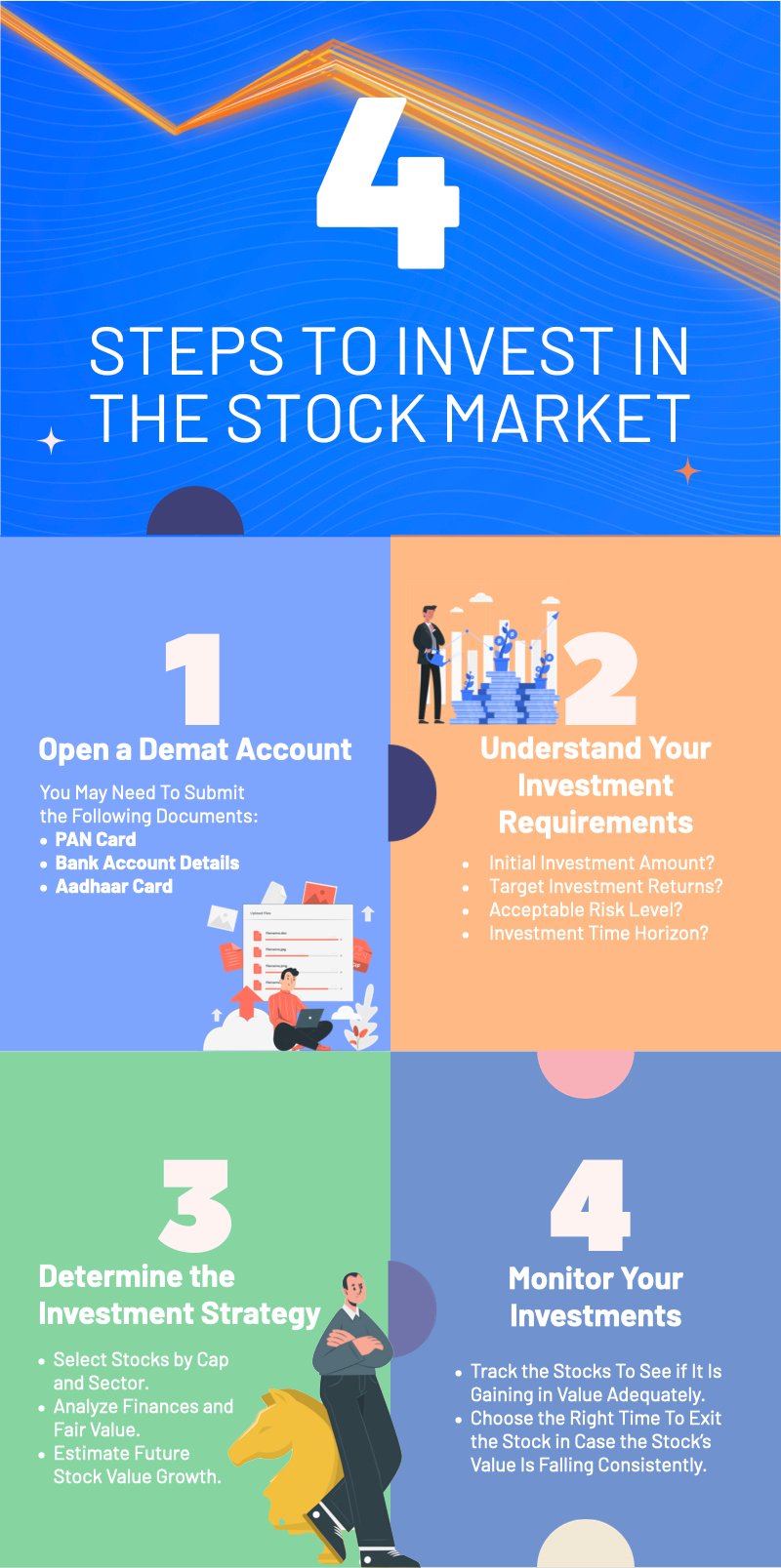
Identify Your Investment Requirements
Before placing the order, investors must determine their needs and limitations. While determining the requirements, users must consider present as well as the future needs. The same rule is applicable while determining their limitations. Investors must list their incomes and deduct all their expenses along with debt obligations (if any) to find the investible surplus. An important factor that will determine the share market investment strategy is investors' risk tolerance. Individuals who do not wish to take higher risks would prefer investing in fixed deposits and bonds. Many investors fail to consider their tax liabilities while investing.
Determine the Investment Strategy
After understanding the personal investment capacity, investors must analyse the share market scenario to frame an appropriate investment strategy. Individuals must identify stocks that suit their needs. For example, if an investor wants an additional source of income, investing in dividend paying stocks is appropriate. For investors who want to grow their capital, choosing growth stocks is an accurate strategy.
Another approach is to compare long-term vs short-term investment. These 2 approaches are determined by time horizon, financial goals and risk horizon. If you want to focus on steady wealth accumulation, a long-term strategy works best. On the contrary, if you plan to generate quick profits by buying and selling assets frequently to capitalise on the immediate price changes, a short-term investing strategy is ideal.
Enter at the Right Time
Entering the market at the right time is one of the most important share market basics often overlooked by investors. The general rule of thumb suggests that one must enter the market when it is low.
Purchasing the identified stocks at the lowest price level will maximise the potential profits investors can earn. On the other hand, exiting when it is trading at the highest price is profitable.
Planning the right entry and exit is the fundamental of share market investment. Without a strong plan in place, you will be like a ship without a compass in the sea. Since the stock market is highly risky, you need to exercise caution beforehand to avoid losses.
Planning entry is based on fundamental and technical analysis. There is no right or wrong analysis method you select, but be careful of what you infer from the result. While selecting a stock, you mustn’t only concentrate on individual stock performance, instead look for cues from general economic performance and macro-economic factors, which might impact share performance. As a rule of thumb, invest in the direction of the trend.
Most successful investors follow four data points, which are P/E ratio, P/B ratio, and Dividend Yield of NIFTY, and FII activity to identify the right entry point.
Execute the Trade
Traders can execute their orders either through offline or online share trading. They can place their orders on the telephone. If an investor chooses the offline method, he must ensure the broker has understood the order correctly to prevent any errors.
Monitor the Portfolio
Many investors make the mistake of investing and not periodically checking their investment portfolio. The stock exchange is dynamic, and conditions are constantly changing. Tracking your investments regularly is important to exit and enter at the right time. Researching about the companies where traders have an interest is crucial to prevent, or at least minimise, losses in case of any extreme situation. However, this does not mean making decisions with every price rise or fall because patience is a vital characteristic for traders to profit through stock investing.
How To Invest in the Stock Market in India? (A Step-by-Step Guide)
Here are the simple steps you need to follow to invest in the stock market in India.
-
Demat account: First, open a demat account with a reputed stock broker. Make sure the demat account is linked to your active bank account.
-
Login: Once your demat account is opened, log in to the account online through your stock broker’s online portal.
-
Pick a stock: You must already be aware that there are thousands of stocks in the market. Now, it's time to pick the best stock that suits your risk and return requirements.
-
Purchase: Once you have picked your preferred stock, you can purchase them by specifying the number of units. Before going ahead with the purchase, ensure sufficient funds are available in your bank account.
-
Portfolio review: Once your purchase order gets executed, the shares will be credited to your demat account. You can go to your portfolio to check the performance of the stock.
Things You Need Before You Invest in Stock Market
Take a quick look at what you need before investing in the share market.
PAN card: To start investing, you must have a PAN card with you.
Demat account: Demat account stands for a dematerialised account, which holds all your investment in digitised format. Since the introduction of demat, issuing physical shares has become a thing of the past.
The modern investing platform has made the process of creating demat account quick and simple. You can open a demat account with a depository participant (DP) or a bank, as most of them offer demat service to customers. When you are opening a demat, you will have to pay certain charges and fees before you start investing.
Trading account: A trading account helps with buying and selling of securities. If you are a trader, you need a trading account to carry out trading activities. While selecting a broker for a trading account, choose one who is registered with both BSE and NSE.
Linking bank account: You will need to move funds to buy and sell stocks. Whenever you are buying, your bank account gets debited, and Demat gets credited. The opposite happens when you’re selling.
Investing in the Stock Market
There are two ways you can invest in the stock market
-
Primary market
-
Secondary market
Investing in the primary market involves investing in initial public offerings (IPO).
Investing in IPOs is a way to invest in a company’s future growth. Whether or not to invest in IPOs is a personal choice, but it gives a good opportunity to diversify portfolios. You can choose to apply for an IPO through your bank or broker.
Companies issue IPOs when they list in the exchanges for the first time. IPO allotment happens through a lottery, depending on market response. It takes a week for an IPO to get listed in the bourses. Once the process gets completed, investors can start trading in the shares in the secondary market.
The secondary market is where buying and selling of stocks happens. The rules of demand and supply govern the secondary market, and negotiation happens buyers and sellers to conduct a trade. To participate in the secondary market, you will need a trading account linked to the demat and bank account.
Factors to Keep in Mind While Investing in Stock Market
Every investor is unique, but there are a few common factors that everyone must keep in mind.
Most investors get stumped by the question of how much to invest in starting. Well, it doesn’t have a one size fits all kind of answer. There is no minimum amount to start investing in stocks, but the size of your investment must depend on your financial goals, income, ability to digest risk, and market condition. Another important factor is the age of an investor. A thirty-year-old investor can take higher risk with his investment (therefore allocate a higher percentage of funds into share investment) than someone who is at the age of fifty. Also, remember that you should invest only the surplus fund.
Another common mistake to avoid is thinking of stock market as a money-making machine. When you start investing in stocks, have a clear view of your goals in mind which will help you navigate through the complex market. Remember that investing is stocks carry inherent risk, and it is important to avoid pitfalls while you are investing. Earning potentially high profit is only possible when you have market knowledge, careful about selecting shares, and adopt a strategy that works.
You can educate yourself on how to invest money in share market by studying the market carefully. It will help you understand share market basics, stock selection methods, and popular trading strategies.
If you are a new investor, avoid leverage, which means borrowing fund from the broker to invest in the market. In the share market, it is a common practice, but it also involves high risk. In case you don’t generate profit from the trade, leverage can prove highly costly. You will end up losing all your investment and will also incur cost on the fund borrowed from the broker.
The stock market investment includes inherent risks, some of which you can’t avoid, but some risks also are stock-specific, which you can evade by excluding such underliers from your portfolio.
Creating a well-diversified portfolio is the best way to beat market volatility, but you need to exercise caution against over-diversification. Your portfolio needs systematic monitoring to adjust it according to market growth.
There are different kinds of stocks traded on the markets. Understanding these various shares before developing the investment strategy to suit personal requirements is recommended.
Stock investments possess challenges, especially if you are new. We suggest that you get clarity over stock market investment so that you don’t get swayed by herd mentality and efficiently set a realistic view. When you are investing in the market, do it with long-term planning. Long term investment has a smoothening effect which will help you override market ups and downs.
Conclusion
Lastly, never leave your investment alone. Many investors make the mistake of not monitoring their investment. But the stock market is dynamic, which means the inherent risk of your portfolio changes regularly. Remember, to scrutinise your investment and news pertaining to the market, which might impact the performance of your investment.
If you are wondering how to invest in share market in India, it is quite simple. You will invest in a regulated environment monitored by the exchange board of India. And now that you have learned how to approach stock market investment, you can start investing right away.